River cruise locks explained: three things you'll notice on deck
 Save
A lock is a chamber built into a river or canal that raises or lowers a vessel between two different water levels. River cruise locks explained simply: the ship enters a sealed section of water, the level inside changes, and gates open on the other side once it matches the next stretch of river. You'll come across this often on European river routes, and once you know what's happening, it's one of the more interesting parts of a cruise rather than a mystery delay. Visit Avon Leisure Cruises for more on what a river cruise day actually involves.
Why rivers need locks at all
Rivers rarely sit at one height along their whole length. Hills, dams, weirs and natural drops mean the water level at one point can be metres away from the level a short distance upstream or downstream. A lock solves that by creating a stepped chamber a ship can pass through safely, rather than facing a sudden drop or a stretch too shallow to float in.
Canal cruises rely on this even more than big river routes, since canals are often artificial waterways cut across land that wasn't flat to begin with. Without locks, a continuous navigable route between two cities simply wouldn't exist.
How do river locks work in practice
The mechanics are simple even though the engineering behind them isn't. The ship sails into a walled chamber, gates close behind it, and water is let in or pumped out until the level inside matches the next section of river. Once the levels match, the gates ahead open and the ship continues on its way.
- Gates at each end seal the chamber completely while the water level changes
- Valves or sluices let water flow in or drain out, raising or lowering the vessel
- The process repeats in a chain on routes with several height changes close together
What happens in a lock, step by step
From the deck, the sequence is easy to follow once you've seen it once.
- The ship slows and lines up with the lock entrance
- Crew and lock staff manage ropes as the vessel moves into the chamber
- The gates close behind the ship
- Water rises or falls until it matches the next section
- The far gates open and the ship sails out
What you'll notice as a passenger
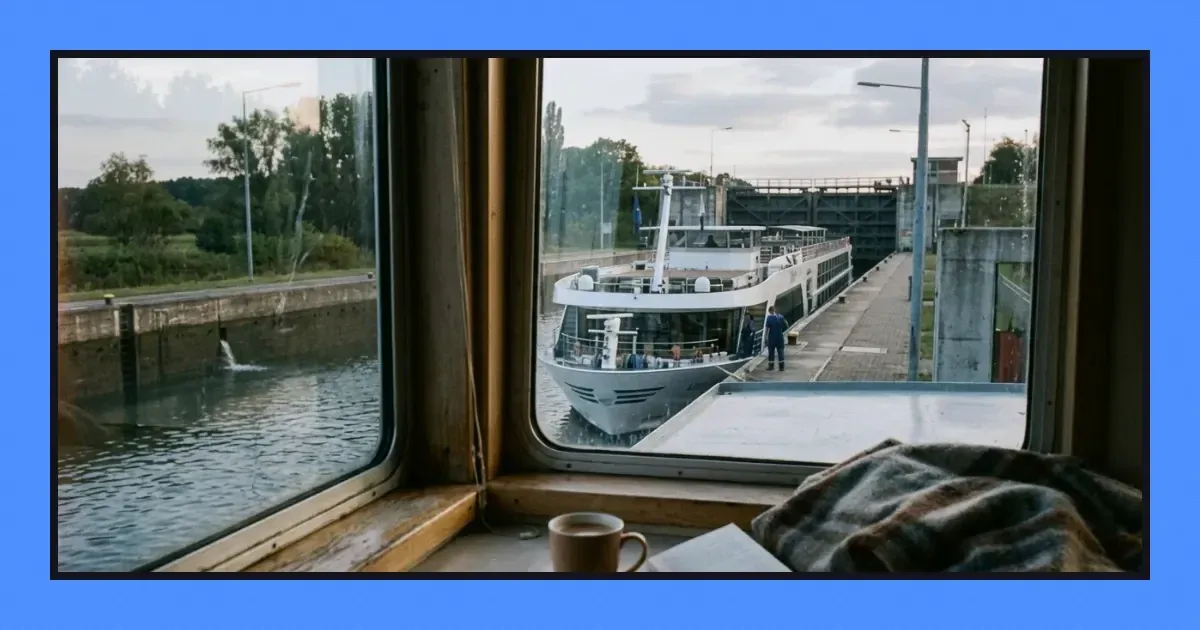
The walls of some locks sit very close to the ship, close enough that you could reach out and touch the brickwork from certain decks. It's a strange sensation the first time, watching the boat rise or sink slowly past stone that seems to tower above or sink below the railings.
Crew often ask passengers to move indoors or keep clear of the rails during the tightest locks, mainly because there's so little clearance either side. Some cruise lines use the moment as a highlight, pointing out the lock's history or engineering while it happens, so it's worth being on deck rather than below when one's coming up.
Noise, timing and sensation
Expect a change in engine sound as the captain manoeuvres carefully, plus the hiss or rush of water moving through the sluices. The whole process can take a while from entry to exit, during which the ship barely moves horizontally. It's a gentle experience rather than a jolting one, closer to standing in a slow lift than anything rough.
Do locks affect the itinerary
Locks are built into the schedule, so a well-planned cruise accounts for the time they take as a normal part of sailing between ports. Where a route includes a long chain of locks close together, the ship's overall pace through that stretch is naturally slower, and the itinerary is designed around that from the outset.
Occasionally, maintenance work, mechanical faults or heavy river traffic can cause a longer wait than planned. This is one of several factors that can affect how low water levels change a sailing plan, since both issues come down to the river's physical limits rather than anything the crew controls.
Comparing locks with other river features
| Feature | What it does | What you notice on deck |
|---|---|---|
| Lock | Raises or lowers the ship between water levels | Narrow walls, slow movement, gates opening and closing |
| Weir | Controls water flow without the ship passing through it | Usually seen from a distance, not sailed through |
| Bridge | Crosses the river without affecting water level | Low clearance may require decks to be cleared briefly |
| Confluence | Where two rivers join and routes may change | A wider, often busier stretch of water |
Where locks sit on different routes
Some rivers are naturally more lock-heavy than others, depending on how much the land height changes along the route. If you're still deciding on a route or itinerary, it helps to read up on choosing your first river cruise, since the number of locks on a route often says something about the pace and scenery you can expect.
Flatter stretches of river tend to have fewer locks and a gentler, faster sailing pace, while hillier terrain or canal sections pack several locks into a short distance. Neither is better than the other, but it's worth knowing which kind of route suits the trip you want.
Is passing through a lock safe and comfortable
For passengers, it's one of the calmer moments of a cruise rather than a cause for concern. The ship moves slowly and under full control the whole time, and crew are trained specifically for the manoeuvre.
If you're prone to feeling uneasy on water generally, locks are actually one of the smoothest parts of a sailing day, since there's no wave motion or swell involved. For wider guidance on settling your stomach during the choppier stretches of a cruise, it's worth reading about managing motion sickness on a river cruise.
The tightest locks can feel dramatic from the deck, but the whole process is one of the most carefully controlled parts of the entire sailing.
Download PDF: Getting ready for a lock on your river cruise PDF, 27 KB
Further reading
Frequently asked questions
Is it normal for a ship to stop moving while in a lock?
Yes, the ship stays almost still horizontally while the water level inside the chamber changes. This is expected and is not a sign of a problem.
How do river locks work on canal routes compared with large rivers?
Canal locks tend to be smaller and more frequent, since artificial waterways often cross uneven land. Large river locks are usually wider and handle bigger changes in water level in a single step.
Can you stay out on deck while passing through a lock?
Often yes, though crew may ask passengers to step back from the railings on the narrowest locks for safety. Each cruise line sets its own guidance depending on the lock's width.
How do locks on canal cruises affect the overall length of a trip?
A route with many closely spaced locks generally sails at a slower overall pace, which is factored into the itinerary from the start. It rarely changes the total number of days, just the rhythm of each sailing stretch.