Taking children on a river cruise – 4 realities that shape the trip
 Save
River cruises appeal to families looking for a quieter alternative to ocean holidays, but most operators set minimum age policies and design their itineraries for adults. The pace is slow, the onboard atmosphere is calm, and shore excursions often focus on museums, vineyards and historical walking tours. Avon Leisure Cruises explores what works for families and what doesn't, so you can decide whether a river cruise suits your children before you book.
Check the operator's age policy first
Many river cruise operators set a minimum age of eight, twelve or even sixteen. Some refuse bookings for anyone under eighteen entirely. The policy appears in the booking terms and is enforced at embarkation, so a child who turns eight the week after departure will not be allowed to board.
A handful of operators welcome younger children and offer family cabins with extra berths, but they are the exception. If the operator's website does not mention children or family sailings, assume they are not welcome.
When an operator does accept children, ask whether the departure you are considering is adults-only by booking pattern. A sailing filled with couples in their sixties will not change its character because one family joins.
Understand what children do onboard
River cruise vessels are small. Most carry fewer than two hundred passengers and have no children's clubs, no pools, no arcades and no dedicated entertainment for younger ages. The day is built around meals, shore excursions and quiet time on deck.
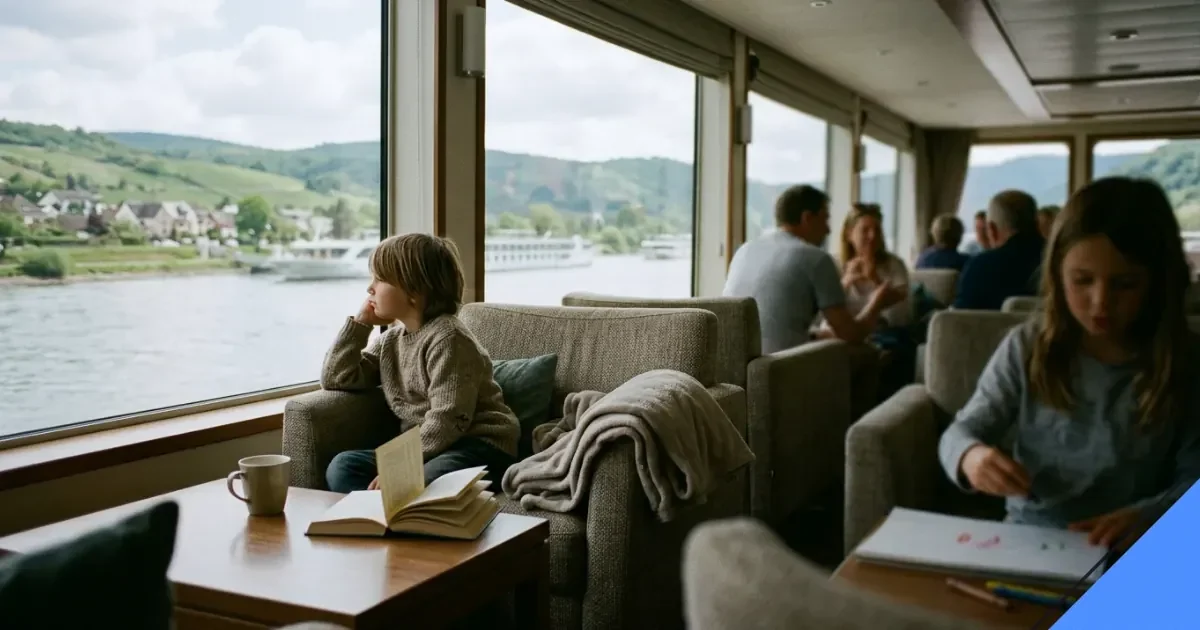
Children who enjoy reading, drawing, watching the scenery and spending time with adults will settle into the rhythm. Those who need structured activity, peers to play with or space to run will struggle after the first day.
Teenagers fare better if they are comfortable in adult company and interested in the destinations. A teenager bored by medieval towns and art galleries will find little to do between ports.
What the dining room expects
Meals are sit-down affairs with multiple courses, often lasting well over an hour. The atmosphere is quiet and the dress code leans smart-casual in the evening. Children who cannot sit through a long dinner, or who need familiar food, will disrupt their own experience and others'.
Operators that welcome families usually offer earlier sittings and simpler menu options, but the galley is not set up to produce separate children's meals on demand.
Consider the shore excursions
Most shore excursions involve walking, standing and listening to a guide for two to four hours. You visit cathedrals, castles, markets and wine estates. The pace suits older passengers who want cultural immersion, not children who tire quickly or lose interest in narrative history.
Some operators offer bike rides and active alternatives, but these still follow the group and keep to the schedule. Free time in port is limited because the vessel departs on a fixed timetable, so there is little opportunity to break away and do something child-focused.
If your children need outdoor play, shorter bursts of attention or hands-on activities, the standard excursion programme will disappoint them. Skipping excursions and staying onboard is possible, but the vessel is quiet during the day and supervision is your responsibility.
What happens if you miss the departure
River cruises work to a strict schedule because locks, moorings and the next port are booked in advance. If your family is late returning from an excursion, the vessel may leave without you. What to do if you miss your river cruise departure covers the steps to take, but avoiding the situation altogether matters more when travelling with children.
Weigh the cabin layout
Cabins on river cruise vessels are compact. A standard double measures around fifteen square metres, with most of that taken up by the bed, a narrow aisle and a small bathroom. Adding a child means a fold-out berth or a connecting cabin, and not all vessels offer either.
Younger children sharing your cabin will have little space to move around or store belongings. Teenagers in a connecting cabin gain privacy, but you will pay for two cabins and the dividing door may not muffle sound effectively.
If your child is restless at night or wakes early, the lack of space becomes a problem for everyone in the cabin. There is no separate lounge to retreat to, and the public areas are not staffed or monitored outside meal times.
Think about the itinerary pace
A river cruise moves slowly. You wake in a new port, spend the morning on an excursion, return for lunch, then either sail to the next stop or have free time in the same town. The rhythm is repetitive and the scenery, while pleasant, does not change dramatically from one day to the next.
Children who thrive on variety and new experiences may find the pace monotonous after three or four days. A week-long cruise can feel much longer when each day follows the same structure and the destinations blur into one another.
Shorter sailings of three or four nights reduce the risk of boredom, but they also compress the cost into fewer days and may not visit the most interesting ports.
Ask whether other families will be onboard
Children travelling with their parents on an otherwise adult sailing can feel isolated. If your child is the only one their age, they have no peers to talk to and must spend all their time with adults who are on holiday themselves.
Some operators run family-focused departures during school holidays, where several families travel together and the atmosphere is more relaxed. These sailings fill quickly and cost more, but they remove the awkwardness of being the only child in a dining room of sixty adults.
If the operator cannot confirm that other families are booked on your departure, assume your child will be the only one.
Be realistic about the cost
River cruises are priced per person, and children rarely travel free. A child occupying a berth in your cabin will be charged at a reduced rate, but that rate is still substantial. Two adults and two children can easily pay as much as four adults would on a comparable holiday.
Shore excursions, drinks and gratuities add to the total, and there is little scope to save money by skipping meals or activities because the experience is pre-structured. Work out what you'll spend on your river cruise before you commit, and include the cost of keeping children entertained during downtime.
Prepare for limited medical facilities
River cruise vessels do not carry doctors. If your child becomes ill or injured, the crew will arrange for you to disembark and visit a local clinic or hospital. The vessel cannot wait, so you will need to make your own way to the next port or fly home.
Travel insurance that covers medical emergencies and missed portions of the cruise is essential when travelling with children, but the disruption and stress of dealing with illness in an unfamiliar country remain.
If your child has a pre-existing condition, check that the operator is aware and that you can access medication and care along the route. Remote river routes may be hours from the nearest hospital.
Decide what matters most
- Read the operator's terms to confirm children are allowed and at what age.
- Ask whether family cabins are available and how much they cost compared to two separate cabins.
- Request details of the shore excursions on your specific sailing, including walking distances and duration.
- Find out whether other families are booked on the same departure, and whether the operator offers child-friendly alternatives to the standard programme.
- Consider your child's temperament honestly: can they sit through long meals, tolerate slow days, and entertain themselves without peers or outdoor space?
River cruises reward patience, curiosity and an appetite for gentle exploration. Children who share those traits, and who are old enough to engage with the destinations, can enjoy the experience alongside their parents. Younger children, or those who need constant activity and familiar routines, will find the format restrictive.
| Aspect | Works well for | Struggles with |
|---|---|---|
| Onboard time | Quiet activities, reading, watching scenery | Need for peers, structured play, physical activity |
| Shore excursions | Interest in history, tolerance for walking and listening | Short attention spans, need for hands-on or outdoor activities |
| Dining | Comfort with formal meals, willingness to try new foods | Fussy eaters, inability to sit still for long periods |
| Cabin space | Older children who need less supervision | Restless sleepers, younger children who need room to play |
What families who sailed say
Parents who have taken children on river cruises report that success depends almost entirely on the child's age and personality. Teenagers interested in European history and comfortable spending time with adults often enjoy the experience and remember the destinations. Younger children, even when technically allowed, find the days long and the environment restrictive.
Families who tried a river cruise and regretted it mention the lack of flexibility as the main problem. Once the itinerary is set and the vessel is moving, there is no way to adapt the day to a child's needs. Shore excursions cannot be shortened, meals cannot be skipped, and there is nowhere to go when a child needs to burn energy or have a tantrum in private.
Those who would sail again with children recommend choosing a departure that other families have booked, bringing books and games for downtime, and managing expectations before you leave home. A river cruise is not a theme park, and children who understand that in advance cope better than those expecting constant entertainment.
Alternatives worth considering
If a traditional river cruise does not suit your family, shorter day trips and canal boats offer similar scenery with more flexibility. Day cruises let you board for a few hours, enjoy the water and the views, then disembark without committing to a week-long itinerary.
Self-drive canal boats give families control over the pace, the stops and the activities. You moor where you like, explore towns at your own speed, and can adjust the day if children are tired or bored. The vessels are simpler and the routes quieter, but the experience is more forgiving for younger passengers.
Choosing your first river cruise and the differences between river and ocean cruising can help you weigh whether a river cruise is the right fit for your family, or whether another style of holiday will serve you better.
This article is for general information only. It does not sell any services or goods.
#Shore excursions #Itinerary #Onboard facilities #Cabin types
Download PDF: Family River Cruise Readiness Checklist PDF, 29 KB
Further reading
Frequently asked questions
What is the youngest age most river cruise operators accept?
Most operators set a minimum age of eight, twelve or sixteen, though some do not accept anyone under eighteen. A small number welcome younger children and offer family cabins, but they are the exception rather than the rule.
Are there activities for children on river cruise ships?
No. River cruise vessels do not have children's clubs, pools, arcades or dedicated entertainment for younger passengers. The day is built around meals, shore excursions and quiet time on deck, with little structured activity for children.
Can my child stay onboard during shore excursions if they find them boring?
Yes, but the vessel is quiet during excursion hours and supervision is entirely your responsibility. There are no staff assigned to watch children, and the public areas are not monitored. Most children staying onboard will need a parent with them.